A 30-Minute Workout Routine for People With No Spare Time
By Anna · Updated November 2026 · 8 min read
Almost every training programme online assumes you have ninety minutes and a shower afterwards. Most people have thirty minutes between finishing work and picking up a child. That is not a reason to skip training — it is a reason to build a programme that fits the thirty minutes rather than one you abandon after three weeks.
The rule: compounds only
In a thirty-minute session there is no room for bicep curls, cable flyes or lateral raises. Every exercise has to move multiple joints and train large amounts of muscle at once. That means five patterns: squat, hinge, push, pull, carry. Four exercises per session, three sets each, is your entire programme.
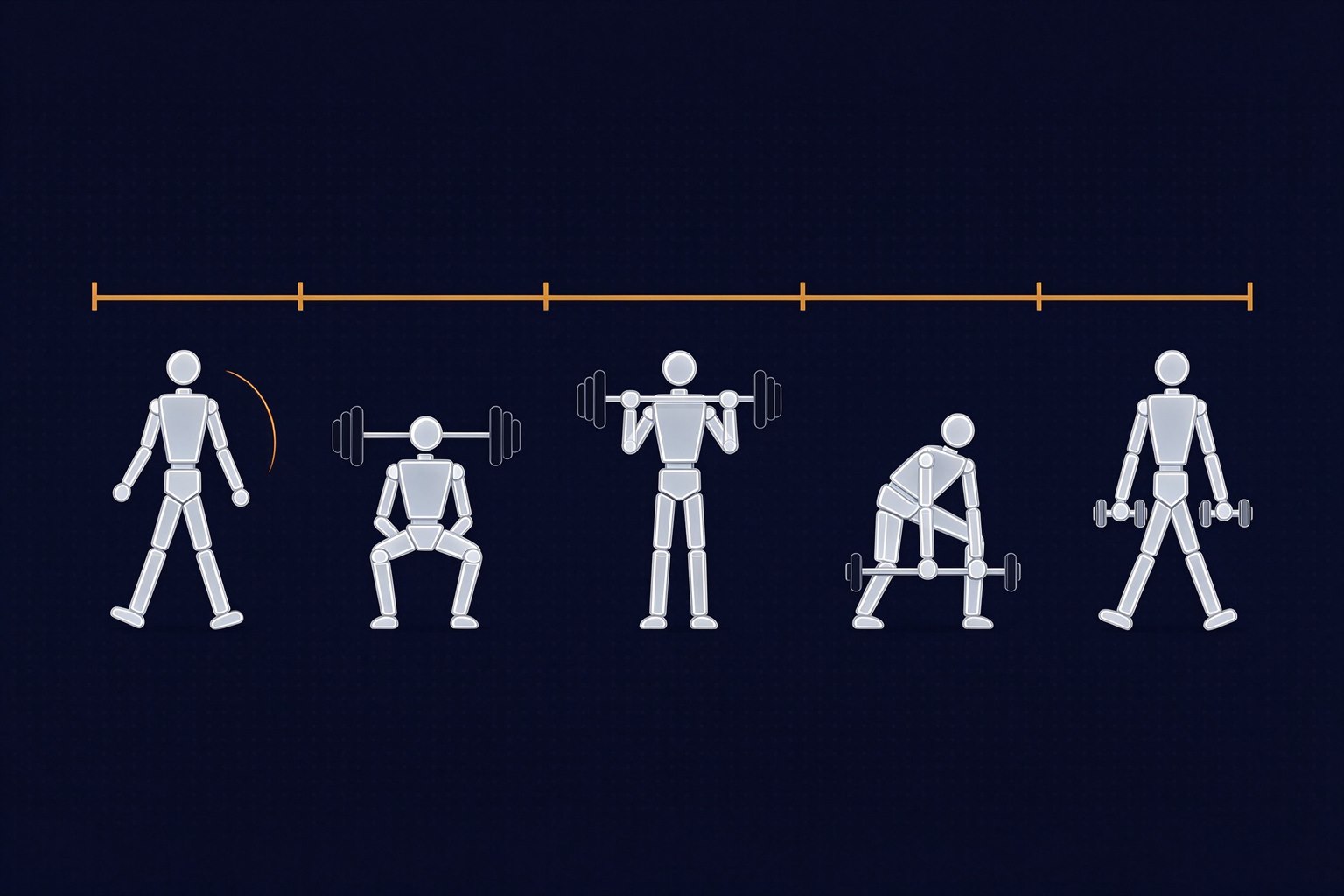
The 30-minute template
| Minutes | What you do | Why |
|---|---|---|
| 0–4 | Warm-up: 2 min brisk walk or bike, 10 bodyweight squats, 10 band pull-aparts | Raises tissue temperature without eating session time |
| 4–12 | Main lift: 3 sets of 5–8, rest 2 min | The heaviest, most technical movement, done while freshest |
| 12–19 | Second compound: 3 sets of 8–10, rest 90 sec | Opposite pattern to the main lift |
| 19–24 | Third compound: 3 sets of 10–12, rest 60 sec | Faster rest because the load is lower |
| 24–29 | Carry or core: 2 sets, then 2 min easy walk | Finishes the session with a low-CNS-cost pattern |
| 29–30 | Log your weights | Without a record, you cannot progress — this is not optional |
The three sessions
Run these Monday, Wednesday and Friday, or any three non-consecutive days. Twenty-four working sets a week covers every muscle group twice, which is the minimum effective frequency.
| Session | Main lift | Second | Third | Finisher |
|---|---|---|---|---|
| A | Back squat 3×5–8 | Bench press 3×8–10 | Barbell row 3×8–10 | Farmer's carry 2×30 m |
| B | Deadlift 3×5 | Overhead press 3×8–10 | Lat pulldown 3×10–12 | Plank 2×45 sec |
| C | Front squat or goblet squat 3×8–10 | Incline dumbbell press 3×8–12 | Seated cable row 3×10–12 | Hanging leg raise 2×10 |
No gym? Swap every movement using the substitution tables in our at-home plan — the structure stays identical.
The three rules that make 30 minutes work
- 1. Do not superset the main lift. Pairing squats with rows sounds efficient but it means neither gets your full attention while you are fresh. Superset only the third exercise and the finisher.
- 2. Take the rests the template specifies. Cutting rest to fit more exercises in is the most common way to turn a good programme into a bad one. Fewer quality sets beat more sloppy ones.
- 3. Protect the three days. Three sessions you actually complete beat five you plan and skip. Pick days you know you can keep and treat them as fixed appointments, not optional ones.
Where to add cardio if you want it
Walk on your days off. Ten minutes after dinner, building to thirty. Do not try to fit running into a thirty-minute lifting session — the two compete for recovery and you will do both badly. If you must combine them, put cardio after the lifting, never before, and keep it easy.
Progressing on a tight schedule
With only three sessions, progression has to be methodical. Use double progression: stay at the same weight until you hit the top of the rep range on every set, then add the smallest increment available and drop back to the bottom of the range. Write it down every session — in a thirty-minute programme there is no slack to waste a month training at the wrong weight because you forgot what you lifted.
Every six to eight weeks, take a deload week: same exercises, 60% of the weight. It feels like losing progress and it is actually what lets the previous six weeks convert into muscle.
Frequently asked questions
Is 30 minutes enough to build muscle?
Yes. Growth depends on hard sets per muscle group per week, not session length. Three focused sessions give most beginners 9–12 sets per muscle group weekly, which is plenty.
Three 30-minute or two 60-minute sessions?
Three shorter ones. Frequency beats duration, and short sessions are easier to keep in a real calendar.
What if I only have 15 minutes?
One compound for 3 sets, one pull for 3 sets. That is a real session. Fifteen focused minutes beats skipping.
Written by
Anna
Yoga & Pilates instructor since 2010, Fitness Yoga Level 6, postnatal recovery specialist. Full credentials →